|
Evolution
of the DH82 Tiger Moth
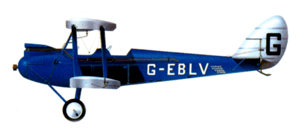 In
the course of development of the DH82 Tiger Moth there were well-defined
stages. In the first place there was the success of the DH60 Moth,
whose prototype was flown for the first time in 1925 by Captain (later
Sir) Geoffrey de Havilland and production of which would run into
thousands. In
the course of development of the DH82 Tiger Moth there were well-defined
stages. In the first place there was the success of the DH60 Moth,
whose prototype was flown for the first time in 1925 by Captain (later
Sir) Geoffrey de Havilland and production of which would run into
thousands.
This small
biplane, equipped with a 60hp Cirrus engine, combined an acceptable
level of comfort for sport flying with the necessary characteristics
for instruction.
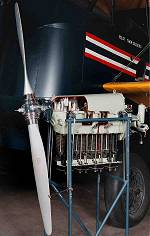 Secondly,
the development of the 100/120hp Gipsy I/II engines, created after
1927 by Major Frank Halford, gradually replaced the Cirrus,
eventually allowing design of the DH60M Metal Moth constructed with
a steel tube fuselage. The military training version, the DH60T Moth
Trainer, was launched with many aerodynamic improvements, reinforced
structure and a maximum weight increased to 1800lb. Secondly,
the development of the 100/120hp Gipsy I/II engines, created after
1927 by Major Frank Halford, gradually replaced the Cirrus,
eventually allowing design of the DH60M Metal Moth constructed with
a steel tube fuselage. The military training version, the DH60T Moth
Trainer, was launched with many aerodynamic improvements, reinforced
structure and a maximum weight increased to 1800lb.
In parallel
with this, work was progressing to produce an 'inverted' Gipsy
engine with cylinders under the crankcase that would improve the
pilot's forward vision, at the same time as increasing the
efficiency of cooling. This was the Gipsy III, which was fitted to
late models of the DH60T, a type modified according to Air Ministry
Specification 15-31 to improve the escape path for the instructor by
moving the centre section forward of the front cockpit.
To restore the centre of gravity, the upper and lower mainplanes
were swept back and in this configuration the aircraft became known
as the DH60T Tiger Moth.
In September
1931, one prototype underwent tests which showed insufficient
distance between the ground and the down aileron. The problem was
rectified simply by increasing the dihedral of the lower planes. As
a result of the final report which was favourable, the type was
ordered as a basic trainer for the RAF under the designation DH82
Tiger Moth.
In 1934 The
Air Ministry ordered a model under the specification T26/33 equipped
with the new Gipsy Major 130hp engine, with a plywood decking on the
rear fuselage substituting for the old configuration of fabric
covered hoops. A retractable canvas hood was available to cover the
rear cockpit for use in instrument flight training.
So was born
the Tiger Moth II as she was called by the RAF but known worldwide
as the DH82A Tiger Moth..
|

